

In and Out: How the 6×5-to-8×7 Grid and Heist Mode Shape Win Potential
NetEnt’s In and Out, released on 18 June 2026, builds its main idea around something more meaningful than simply making a slot grid larger. Every paid round starts on six reels and five rows, but Bomb symbols can gradually extend the active area until it reaches eight reels by seven rows. At the same time, winning positions are marked and upgraded through Bronze, Silver, Gold and Diamond tiers, creating a record of where successful combinations have appeared during the current sequence. Those two systems meet in Heist Mode, where the size and quality of the prepared area directly influence what can happen next. The result is a slot in which a larger grid is useful not because extra positions automatically produce a bigger win, but because they create more room for Avalanche wins, highlighted cells and Heist Mode activity. With an advertised RTP of 96.08% and a maximum payout of 12,086× the stake, In and Out makes its highest potential dependent on several mechanics working together rather than on one isolated bonus symbol.
Why Expanding from 6×5 to 8×7 Changes the Round
The standard In and Out layout contains 30 positions: six reels multiplied by five rows. At the maximum size, eight reels and seven rows provide 56 positions. That is a substantial increase in the amount of space available during the same game round. It should not be interpreted as a simple mathematical promise that an 8×7 grid will pay more, because every spin remains random and extra positions do not guarantee winning symbols. What the larger layout does provide is more space in which the game’s existing mechanics can operate. New symbols can enter during Avalanches, more positions can potentially become highlighted, and Heist Mode can ultimately work across a broader section of the screen if the necessary conditions are created.
Expansion comes from Bomb symbols rather than from a fixed progression. When a Bomb lands, it removes itself and the immediately adjacent regular symbols, leaving room for another Avalanche. Its position matters. A Bomb appearing on an outer edge can add a reel or a row in that direction before the next symbols arrive, while a Bomb in a corner can add both at once. The game limits expansion to one addition in each direction during a round, with 8×7 representing the maximum. This means reaching the full layout is an event produced by the sequence of symbols within a round rather than a permanent upgrade that remains active for ordinary subsequent spins.
This distinction is important when assessing win potential. A player is not simply waiting for the game to become 8×7; the useful outcome is a larger grid combined with productive Avalanches and highlighted positions. An expanded area that produces no meaningful continuation may add little to the final result, whereas expansion followed by several wins can prepare a much stronger setup for Heist Mode. In practical terms, the 8×7 maximum is best viewed as extra capacity. It gives the game more room to build a valuable sequence, but the actual value still depends on which symbols arrive, which positions win repeatedly and whether Chloé appears at the right stage of the round.
How Avalanches Turn Extra Space into Useful Positions
The Avalanche mechanic provides the link between ordinary wins and the later bonus action. Whenever a winning combination appears, the symbols involved are removed and new symbols fall into the empty spaces. The game then checks the new arrangement for another win, and this process continues for as long as fresh winning combinations are formed. More importantly, positions involved in a scattered win become highlighted. A position starts at Bronze, then moves to Silver, Gold and finally Diamond if later wins continue to use the same location. The sequence therefore creates something that remains relevant after the immediate cash value of the original win has already been calculated.
Expansion helps because it can create additional positions on which this process may take place. A standard 6×5 screen has less physical room for highlighted cells than an expanded 8×7 screen. If Bombs enlarge the grid early enough and subsequent Avalanches use some of those new positions, the active setup can become broader before Heist Mode begins. However, quantity is only part of the picture. A smaller area containing several Gold or Diamond positions may be more valuable than a much larger area made almost entirely of Bronze positions. In and Out therefore rewards favourable combinations of grid size and tier quality rather than treating every highlighted position as equal.
The tier system also explains why repeat activity in the same part of the grid matters. Bronze positions are only the beginning of the progression. Repeated wins can raise individual cells towards Diamond, and those higher tiers later support much larger values during Heist Mode. This gives a long Avalanche sequence two possible benefits at once: it can produce immediate wins and improve the structure available for a later feature. The player has no control over where those repeat wins appear, but visually the system makes it possible to understand why one Heist Mode setup may carry noticeably greater potential than another even before the feature begins.
How Heist Mode Converts Grid Progress into Win Potential
Heist Mode is the point at which the preparation created by Avalanches becomes especially important. According to NetEnt’s rules, the mode can begin when a highlighted area and the Chloé symbol are present after all Avalanches have finished. Chloé then enters the highlighted section, and the feature starts with three spins. Instead of simply replaying the normal reels, the unoccupied positions inside the active Heist area spin independently. Coins, Diamonds, Bonus symbols and dedicated Heist Mode symbols can appear there, turning the highlighted cells accumulated earlier in the round into a separate collection feature.
The value available from a position depends heavily on its tier. Bronze positions can produce Coins worth 0.5×, 1×, 1.5× or 2× the bet. Silver raises the possible Coin values to 4×, 6×, 8× or 10×, while Gold positions can contain 15×, 20×, 25× or 30× values. Diamond positions use Diamond symbols instead of ordinary Coins, with possible values of 50×, 100×, 200× or 1,000× the bet. These values show why the highlighted progression is more than a visual effect. A cell upgraded several times before Heist Mode can have a very different value range from one that has only just reached Bronze.
This also clarifies the role of the 8×7 grid. Expanding the screen does not increase every Coin multiplier or transform Bronze cells into Diamond cells automatically. Instead, it raises the number of positions that could potentially become part of the Heist. If a larger grid is accompanied by enough winning activity, Heist Mode may have more places in which Coins and special symbols can operate. Conversely, an expanded screen with only a handful of highlighted cells may produce a comparatively compact feature. The strongest potential therefore comes from interaction between space, highlighted coverage and tier upgrades rather than from grid expansion alone.
Special Heist Symbols Can Reshape the Active Area
Once Heist Mode has started, several special symbols can alter the setup. The Multiplier is one of the most straightforward: it can carry a value of 2×, 3×, 4×, 5× or 10× and applies its effect to Coins, Diamonds and Collectors at the end of the mode. Because Coins and Diamonds can already carry substantial values, particularly on Gold and Diamond positions, a favourable Multiplier can materially change the final amount. It remains random, however, and the existence of a large grid does not ensure that a Multiplier will appear or that it will arrive alongside high-value symbols.
The Upgrader and Burst affect the structure rather than merely adding a fixed value. An Upgrader raises adjacent positions by one tier and can bring previously inactive positions into Heist Mode at Bronze level. It can also improve Coins on affected cells. A Burst turns a random selection of previously unhighlighted positions into active cells matching the Burst’s own tier. Its effect may even reach outside the current play area and expand it. If an Upgrader and Burst appear together, the resulting Blast combines their effects and can place Coins into newly affected empty positions. These mechanics mean that a modest Heist Mode can sometimes grow after it has already started.
Extra Life and Collector symbols influence the feature in different ways. Extra Life adds another Heist Mode spin, which matters because the mode normally begins with only three. An additional attempt can provide another chance for Coins, Diamonds or one of the structural modifiers to appear. A Collector gathers the current value of Coins, Diamonds and other Collectors in the active area while freeing occupied positions for further activity. Together, these special symbols make the number of usable positions important in a practical sense: a broader area offers more potential locations for the feature to develop, but the final result still depends on the random combination and timing of the symbols that actually land.
Free Spins Add Persistence to the Expanding Grid
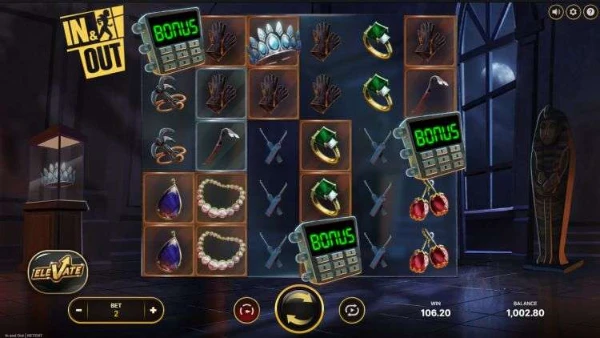
One of the most significant differences between an ordinary paid round and Free Spins is what happens to the prepared grid. Three Bonus symbols of either eligible type activate Free Spins after the Avalanche sequence has finished, with the feature beginning from five spins. Each Super Bonus symbol among the triggering symbols adds another spin. More importantly for the expanding-grid mechanic, the grid size and highlighted positions created during the triggering base-game round are carried into Free Spins and remain available until they are used by Heist Mode. Expansion therefore has a longer period in which to matter than it normally does during a single paid round.
Consider the difference between entering Free Spins from a basic 6×5 setup and entering with part of the grid already expanded and several positions upgraded. Both features remain random, and neither starting condition guarantees a worthwhile result. However, the second setup has already completed part of the work that the game’s mechanics are designed to perform. Bombs and Heist Mode remain available during Free Spins, so the grid can potentially grow further and new highlighted positions can be created. Landing one Bonus symbol during the feature awards an additional spin, while two Bonus symbols award two extra spins, giving a successful sequence more opportunities to continue.
Super Free Spins take the size advantage one step further because they begin with the maximum 8×7 grid. That removes the need to wait for enough edge Bombs to create the full layout before other mechanics can use it. It does not remove the random nature of the game: the extra 26 positions compared with the starting 6×5 grid still need useful symbols, wins and upgrades to become valuable. What Super Free Spins provide is the maximum amount of working space from the outset. For a game built around converting highlighted cells into Heist Mode positions, that is a meaningful structural advantage even though it remains impossible to predict the payout of an individual feature.
Why Maximum Grid Size Is Potential Rather Than a Promise
In and Out has a published maximum payout of 12,086× the bet, but the existence of an 8×7 grid should not be confused with a direct route to that figure. Several favourable events would need to align for the game’s upper potential to become relevant: useful grid expansion, repeated Avalanche wins, higher-tier positions, activation of Heist Mode and productive special-symbol interactions. Even within Heist Mode, the best Diamond value of 1,000× is only one possible random value on an eligible Diamond position. Multipliers and Collectors can increase the importance of existing values, yet none is guaranteed to land in a particular feature.
The headline RTP shown by NetEnt is 96.08%, but RTP describes theoretical performance over a very large number of rounds rather than what one player should expect from a short session. The official game page also lists stakes from €0.20 to €40 per spin. Those figures are more useful when treated as game specifications than as predictions. Grid expansion, tier progression and Heist Mode influence the distribution and size of possible wins, but they do not make the result of the next spin more predictable. A full screen can end with limited value, while a smaller Heist with strong tiers and favourable special symbols can sometimes be more productive.
The most useful way to understand In and Out is therefore to follow the chain of mechanics rather than focusing on the 8×7 headline in isolation. Bombs create room, Avalanches turn positions into tiered areas, repeated wins improve those tiers, and Chloé can convert the prepared section into Heist Mode. Special Heist symbols may then extend, upgrade, multiply or collect the values already in play. Free Spins give some of this progress additional persistence, while Super Free Spins begin with the largest possible grid. NetEnt has effectively made grid size one ingredient in a wider system: more space raises the ceiling for what the round can build, but the actual win still depends on how effectively that space is populated and upgraded by random game events.